An open lakehouse you actually own.
Hi,
Knowledge about Apache Iceberg is not spreading as easily as it should. Before you can start, you need quite a few components: a catalog, object storage, identity, an engine and a place to work. Vendors make that part easy, and that is usually where vendor lock-in starts.
So I built a small platform that shows the other route: every building block open source, running on one laptop with a single command. Apache Iceberg is a very good choice for autonomy and portability.
Read morehttps://medium.com/@sanderdw/making-apache-iceberg-feel-like-a-database-service-e89c5d0bed98
https://www.linkedin.com/posts/sanderdw_at-alliander-we-want-to-take-data-sharing-ugcPost-7505007789820256256-eoeA/
- How Iceberg actually works, and why it is not a platform like Snowflake.
- What a fully open source stack gives us: autonomy, portability and no lock-in.
- A demo of one grid sensor data product: loaded by a team, given meaning by a coding agent, shared with another team, listed in a data catalog and asked about in a chat.
Five principles behind every choice
Apache Iceberg is doing for data what open APIs did for applications.
How Apache Iceberg works
And why it is not a database platform like Snowflake.
Iceberg is a specification, not a product you buy
- One vendor delivers storage, compute, catalog, security and the UI as a single product.
- Your tables live in the vendor's format and in the vendor's account.
- You rent the capability, so leaving means migrating the data and everything built around it.
- An open specification for how table data and metadata are laid out in object storage.
- Data files are plain Parquet and metadata is JSON and Avro, so no server owns them.
- You bring the catalog, the engines, the storage and the identity provider, and each one stays replaceable.
Start with what you already know: PostgreSQL
Imagine a simple table: columns, rows and SQL queries.
| Who does the job? | A regular PostgreSQL table | An Iceberg table in this platform |
|---|---|---|
| Run your SQL | The PostgreSQL server. | An engine such as DuckDB or Spark. |
| Find the table and check access | PostgreSQL's system catalogs and permissions. | Polaris: the table's name, permissions and current metadata location. |
| Describe the columns | PostgreSQL's system catalogs. | An Iceberg metadata file in object storage. |
| Store the rows | Files managed and read by PostgreSQL. | Parquet files in a bucket, read directly by the engine. |
| Scale storage and compute | One server: more data or more queries means a bigger server. | Separate: storage grows in the bucket, and each engine brings its own compute. |
Every building block is open source
| Capability | Component | Version | License | Swappable for |
|---|---|---|---|---|
| Table format | Apache Iceberg (PyIceberg) | spec v2 and v3 · 0.12 | Apache-2.0 | The standard itself, engines come and go. |
| Catalog and permissions | Apache Polaris | 1.8.0 | Apache-2.0 | Lakekeeper, Nessie, Gravitino, Unity Catalog OSS, AWS Glue |
| Identity (OIDC) | Keycloak | 26.8.0 | Apache-2.0 | Entra ID, Okta, any OIDC provider |
| Object storage (S3 API) | RustFS | 1.0.1 | Apache-2.0 | AWS S3, MinIO, Ceph, Cloudflare R2, on-prem |
| Catalog metadata store | PostgreSQL | 18 | PostgreSQL | Managed Postgres anywhere |
| Notebooks | marimo | 0.25.1 | Apache-2.0 | Jupyter, VS Code, any Python client |
| Query engine | DuckDB with the iceberg extension, reads and writes | 1.5.6 | MIT | Trino, Spark, Flink, Polars, ClickHouse |
| Portals and API | FastAPI, Python 3.14 | 0.143 | MIT | Built here, deliberately thin. |
| Semantic models | Apache Ossie (incubating), stored by Polaris | spec 0.2.0 | Apache-2.0 | Any tool that reads the open specification |
| Agent interface | Model Context Protocol, Python SDK | 2.3 | MIT | Any MCP client: Claude Code, IDEs, a custom agent |
| Conversational BI (extension) | Pydantic AI, CopilotKit, Chart.js, DuckDB | 2.55 · 1.79 · 4.5 · 1.5.5 | MIT | Any LLM provider: OpenAI, Anthropic, Gemini, Bedrock |
| dbt pipelines (extension) | dbt v2 OSS on DuckDB | 2.0.8 · 1.5.5 | Apache-2.0 | Any dbt adapter for an Iceberg engine |
| Ingestion (extension) | dlt with its Iceberg destination | 1.31 | Apache-2.0 | Airbyte, Meltano, any Iceberg REST writer |
| Data catalog (extension) | OpenMetadata, fed through its REST API | 2.0.5 | Apache-2.0 | DataHub, Unity Catalog OSS, Apache Atlas |
The platform
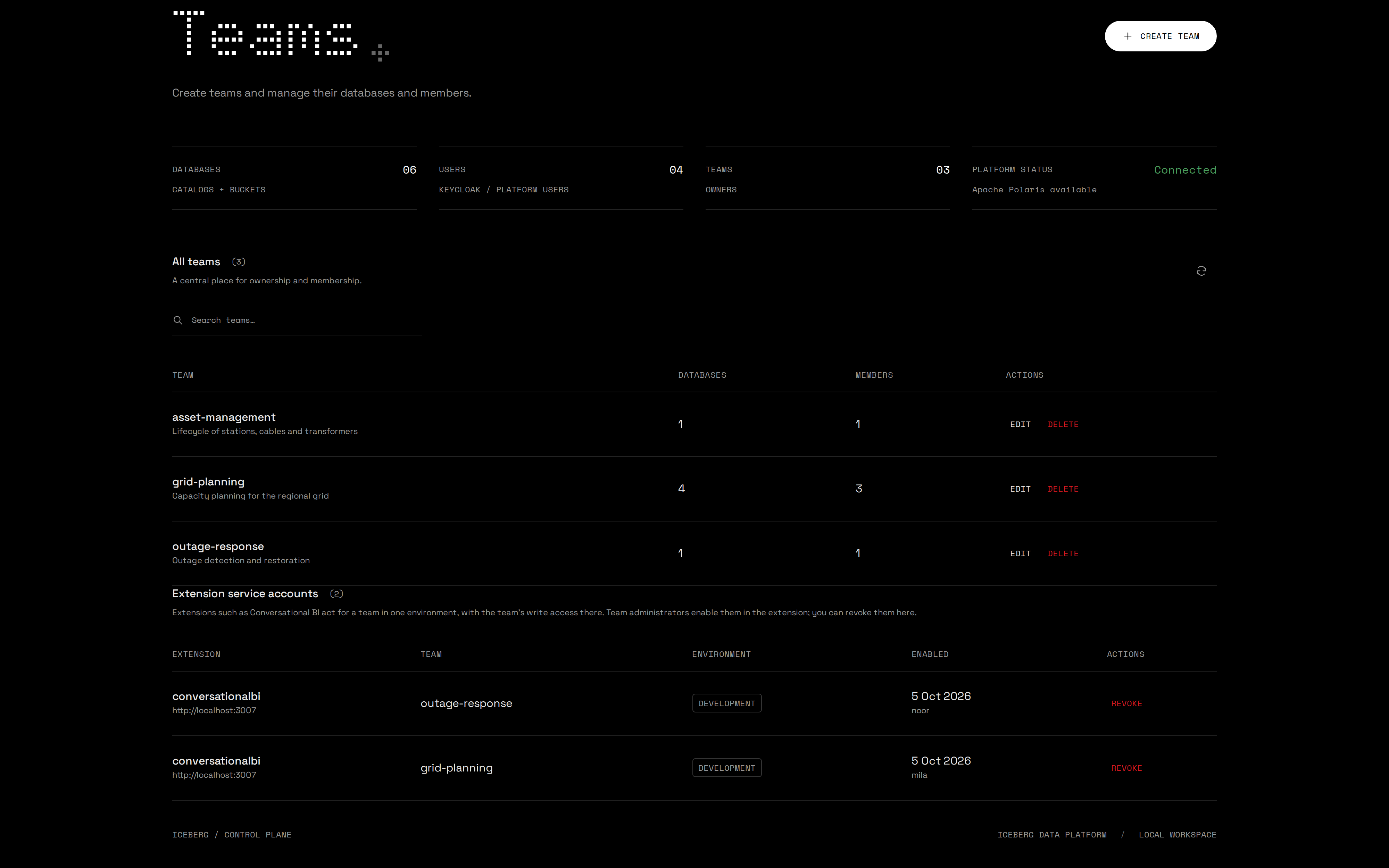
Teams, databases, AI agents and extensions, on one identity and with each user's own permissions throughout.
Architecture
Polaris RBAC per team: the high-level view
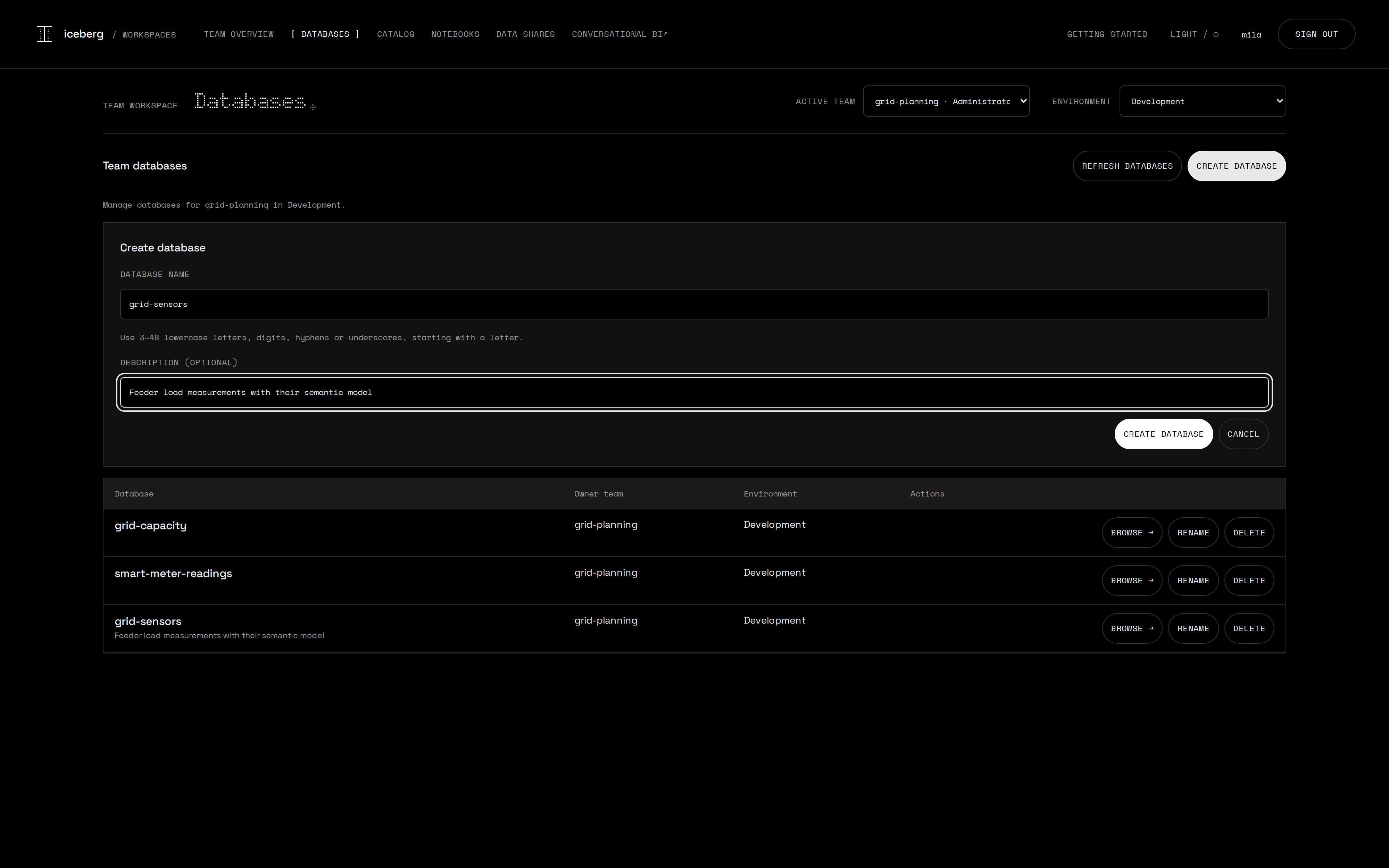
Team administrators run their own databases
The catalog, for an AI agent
claude mcp add --transport http \
  --client-id iceberg-mcp --callback-port 3010 \
iceberg-user http://localhost:3002/mcp| list_databases | Teams, the role in each, owned and shared databases |
| list_namespaces · list_tables | Only what the grants allow |
| describe_table · describe_view | Schema, partitioning, snapshots, branches, view SQL |
| list_semantic_models · describe_semantic_model | Datasets, joins, agreed metrics and AI context · a summary, searchable, for large models |
| query_semantic_model | Answers from the agreed metrics and joins, read with the user's own grants |
| list_dimension_values | Exact filter values, such as Example Dunmore |
| preview_rows | Up to 100 rows, at any snapshot |
| list · create · update · delete_share | Team administrators only · sharing a model adds its tables |
| create · rename · delete_database | Team administrators only · delete needs the exact name |
- The agent signs in through Keycloak as you: a public client with PKCE, no secret to store.
- Every call runs with your Polaris grants, so the agent sees exactly what you see and nothing more.
- The agent never writes SQL: it names metrics, dimensions and filters, and the portal builds the query from the semantic model, so a metric always uses the agreed definition.
- A shared database stays read-only for the agent too.
- Destructive tools are marked as such, and the agent is told to ask before using them.
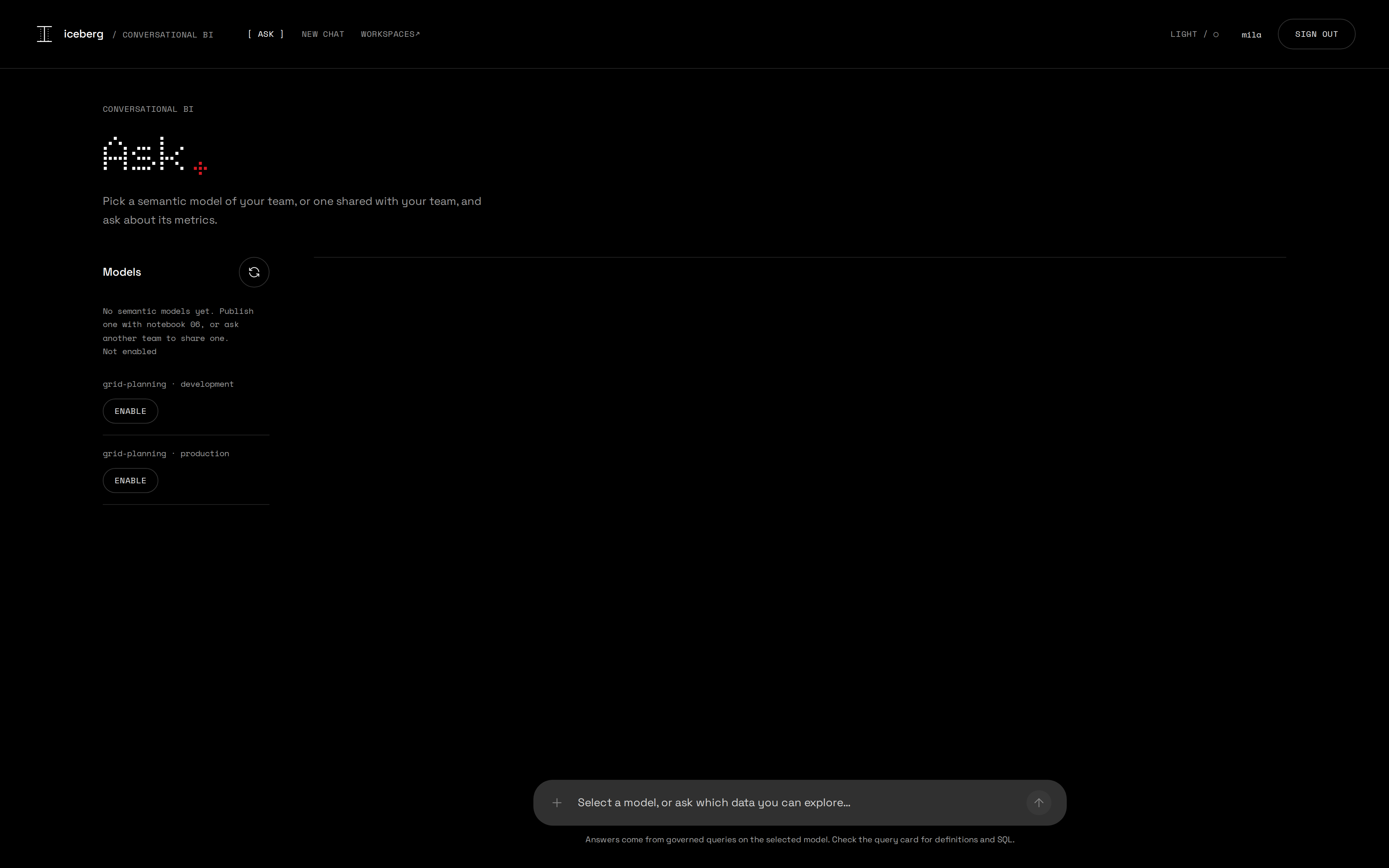
Keep the core small: extensions come in through one Bridge
Team administrators switch it on, the platform keeps oversight
Security model, in one slide
- The user portal, Polaris, the notebooks and MCP all work with that user's Keycloak token. No shared service account for data access.
- Polaris vends short lived, table scoped S3 credentials; notebooks never see bucket root keys.
- Each notebook session gets its own container and network: read-only root filesystem, dropped capabilities, CPU, memory and process limits, no Docker socket.
- Revoking a membership stops the affected runtimes within 30 seconds.
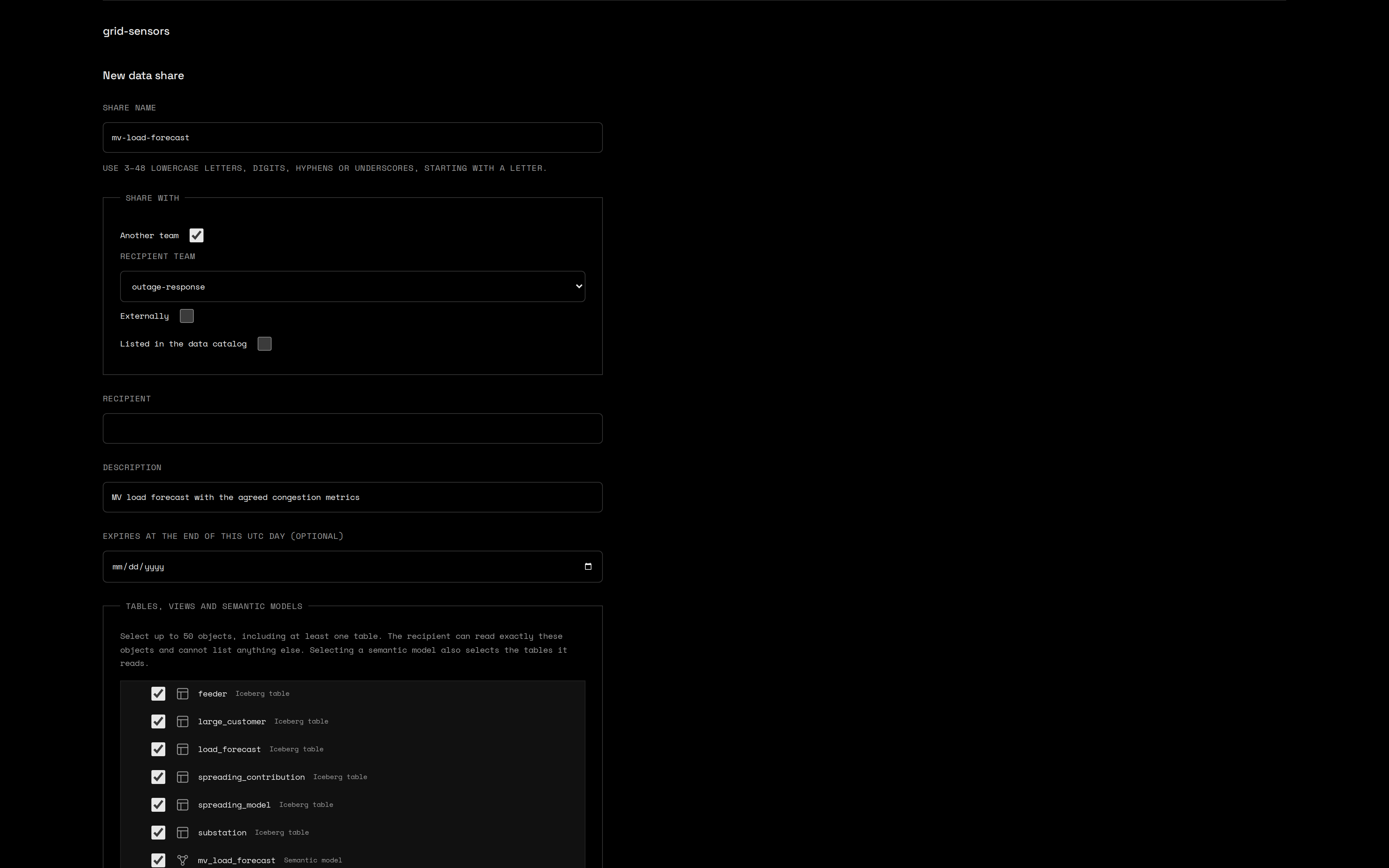
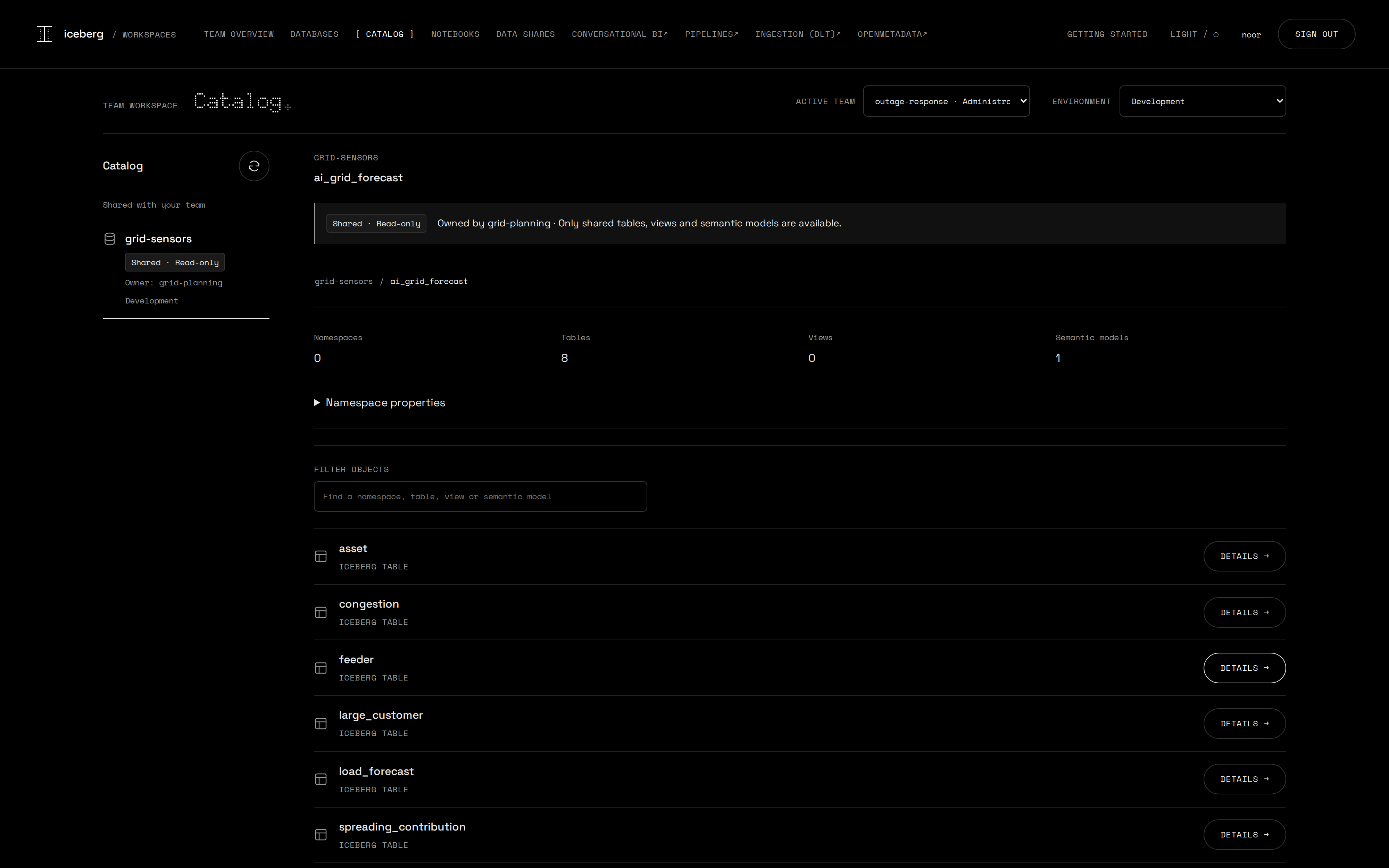
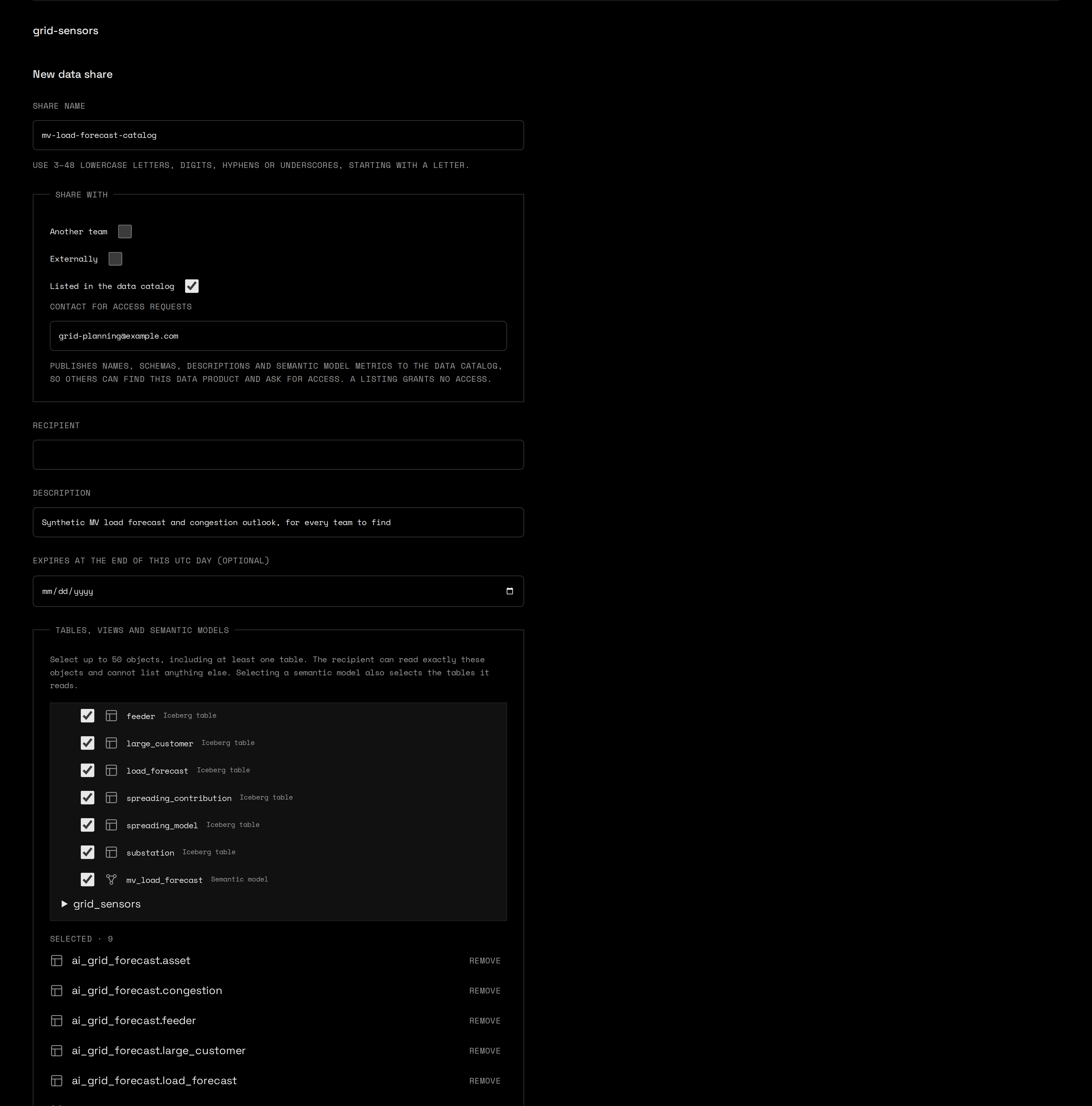
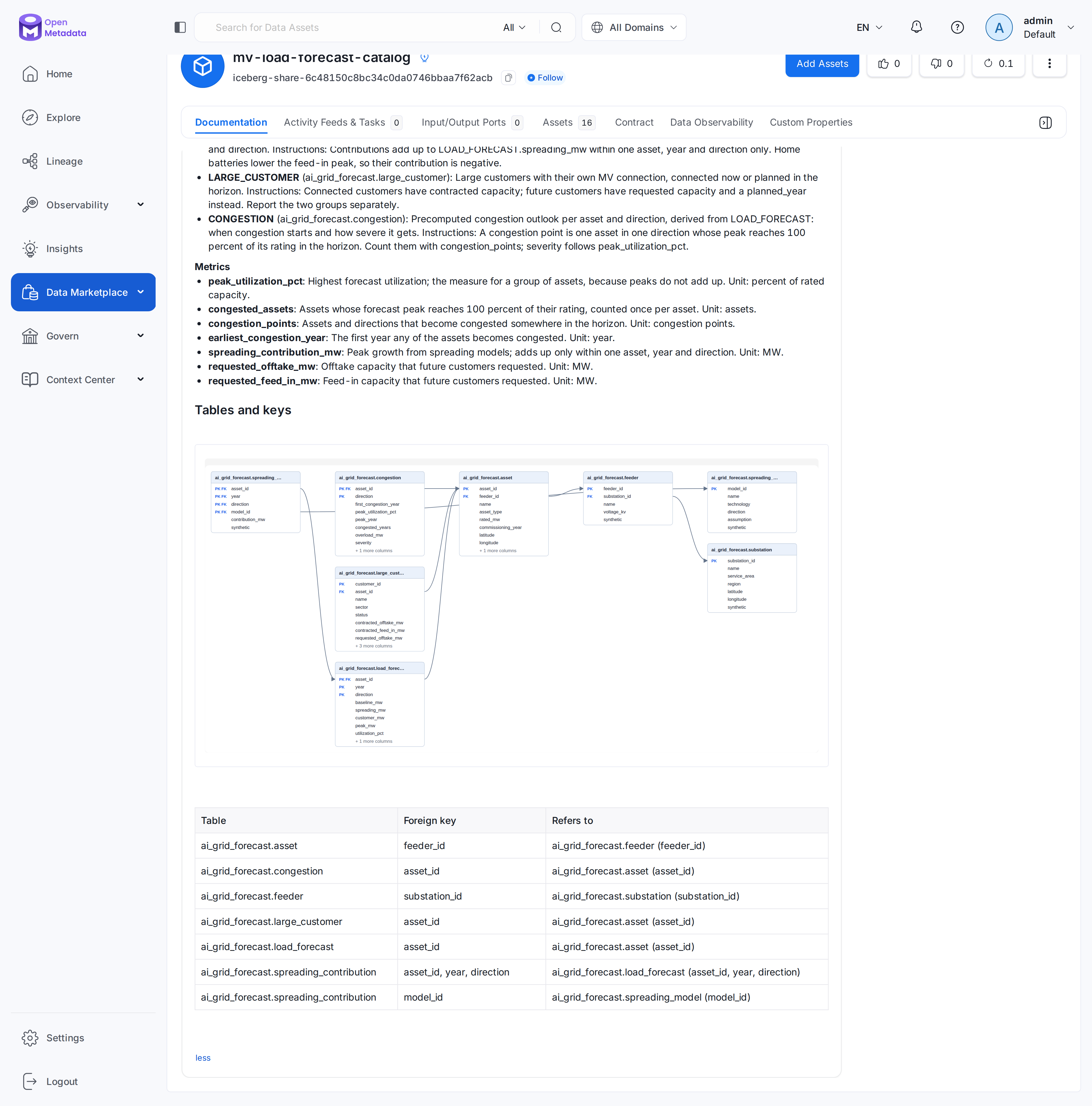
- A data share holds one read grant per table, view or semantic model. A receiving team never gets administration; an external secret is shown once, never stored. A listing in the data catalog publishes metadata only.
- MCP accepts only tokens issued to the
iceberg-mcpclient, verified on every call: an agent never holds more than its user. - Extensions get no platform secrets or storage keys: a team's service account, enabled by its administrators and revocable by the platform administrator. dbt and Ingestion runs are isolated containers with a short-lived token.
From raw data to answers
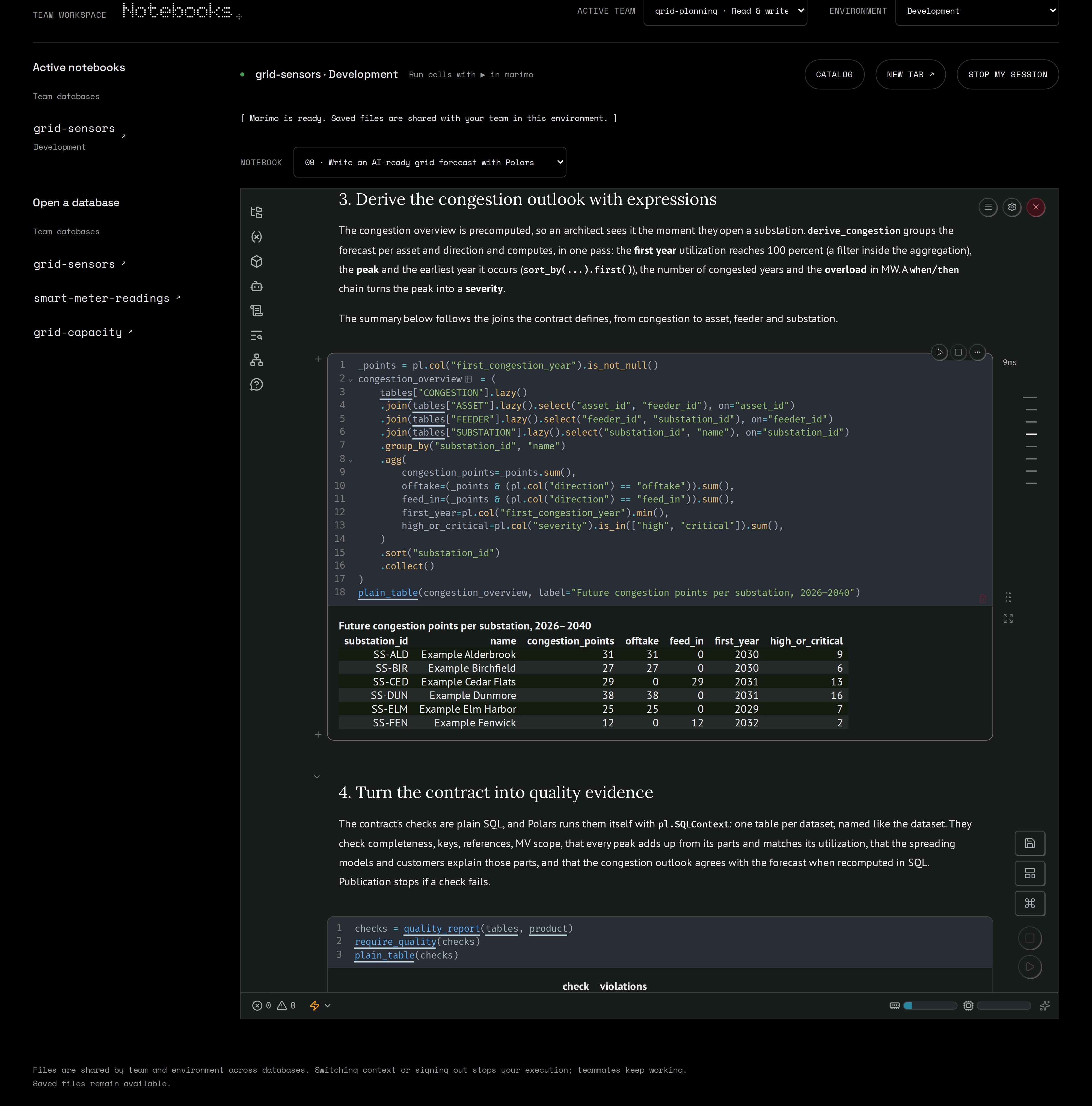
A load forecast written in a notebook, given meaning by its contract, shared, listed in a data catalog and asked about in a chat.
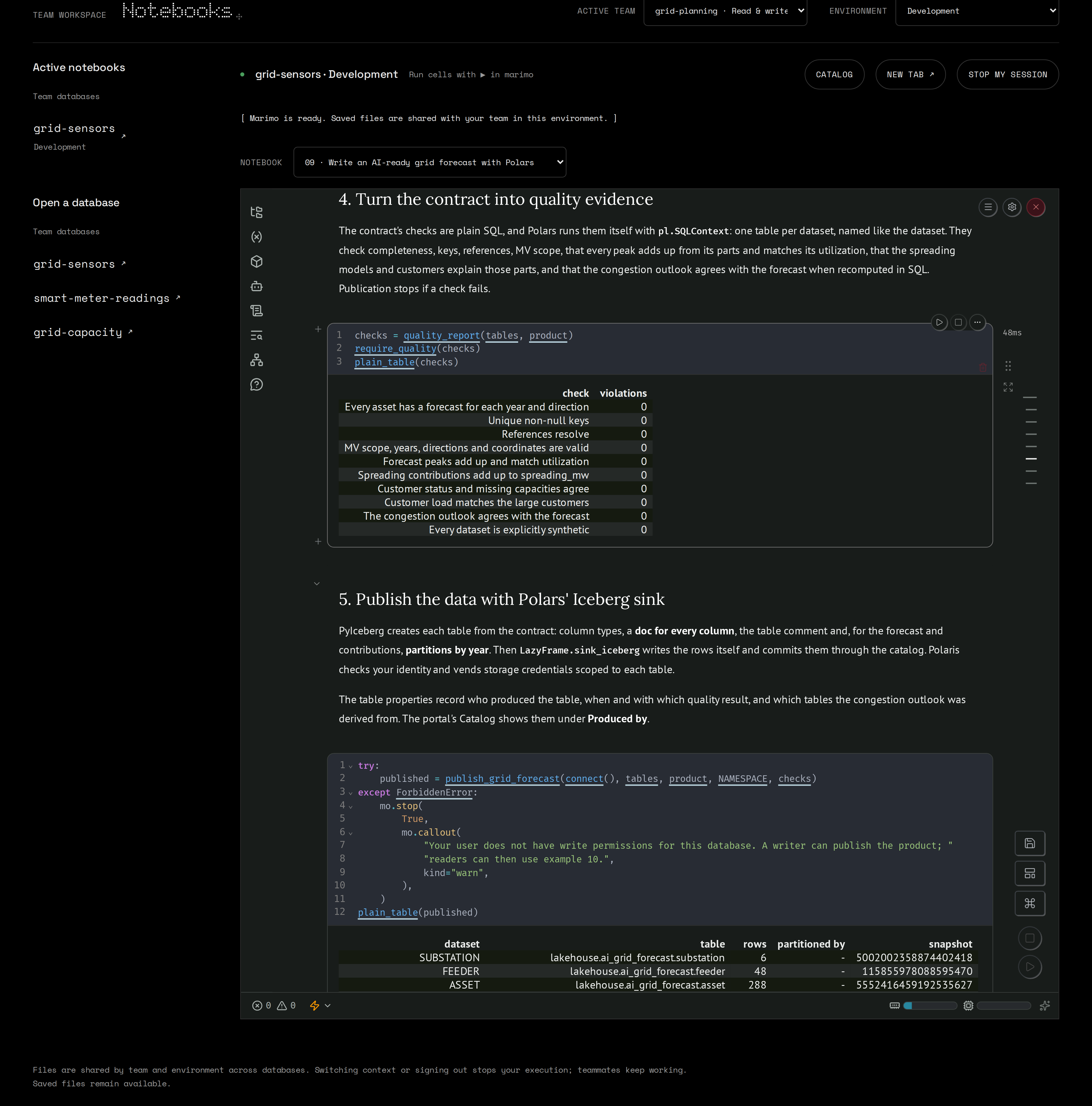
A notebook checks the data product, then writes it
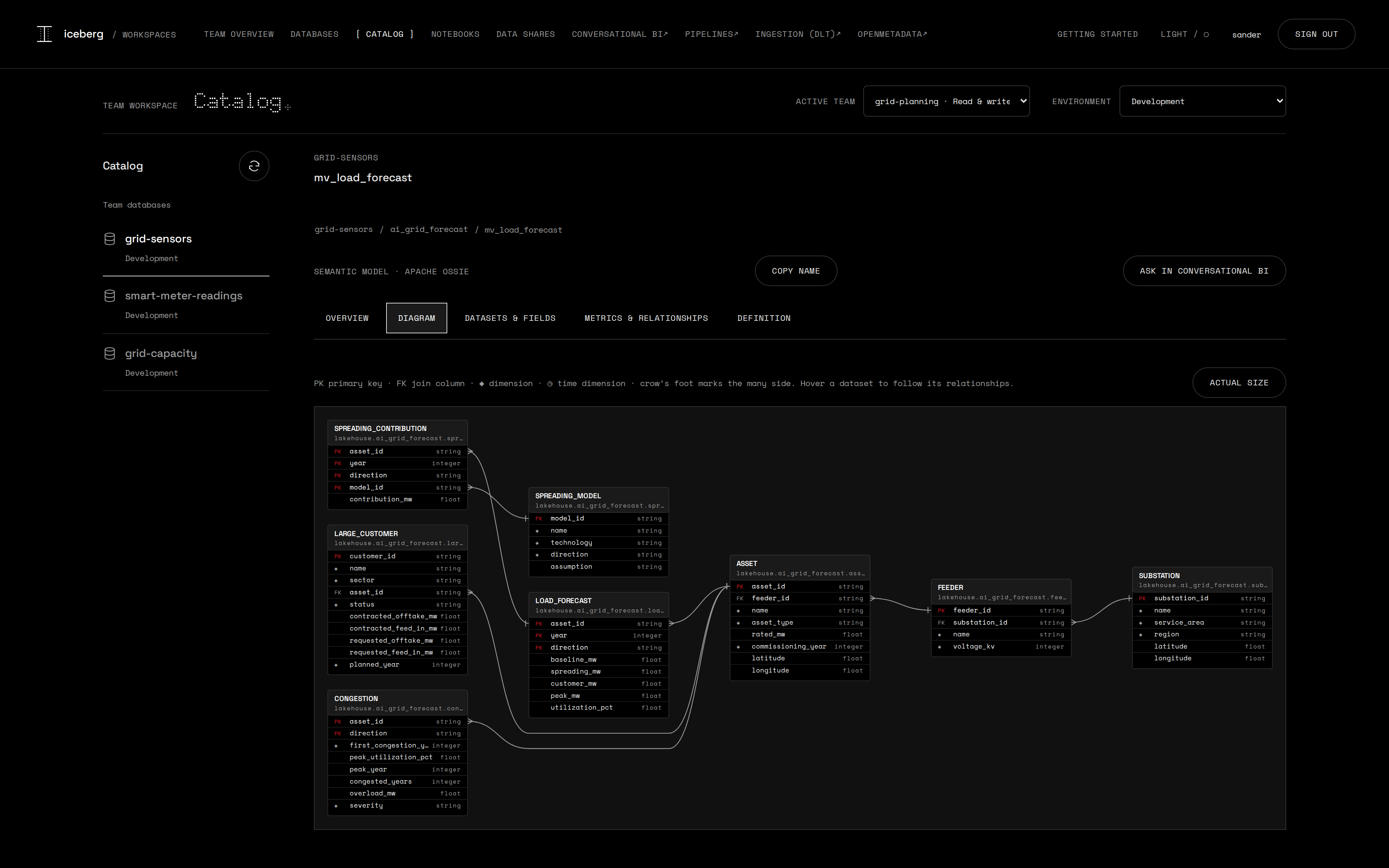
The meaning, stored beside the tables
Share the model with another team, without a copy
List it in the data catalog, so others find it
noor asks the shared model a question
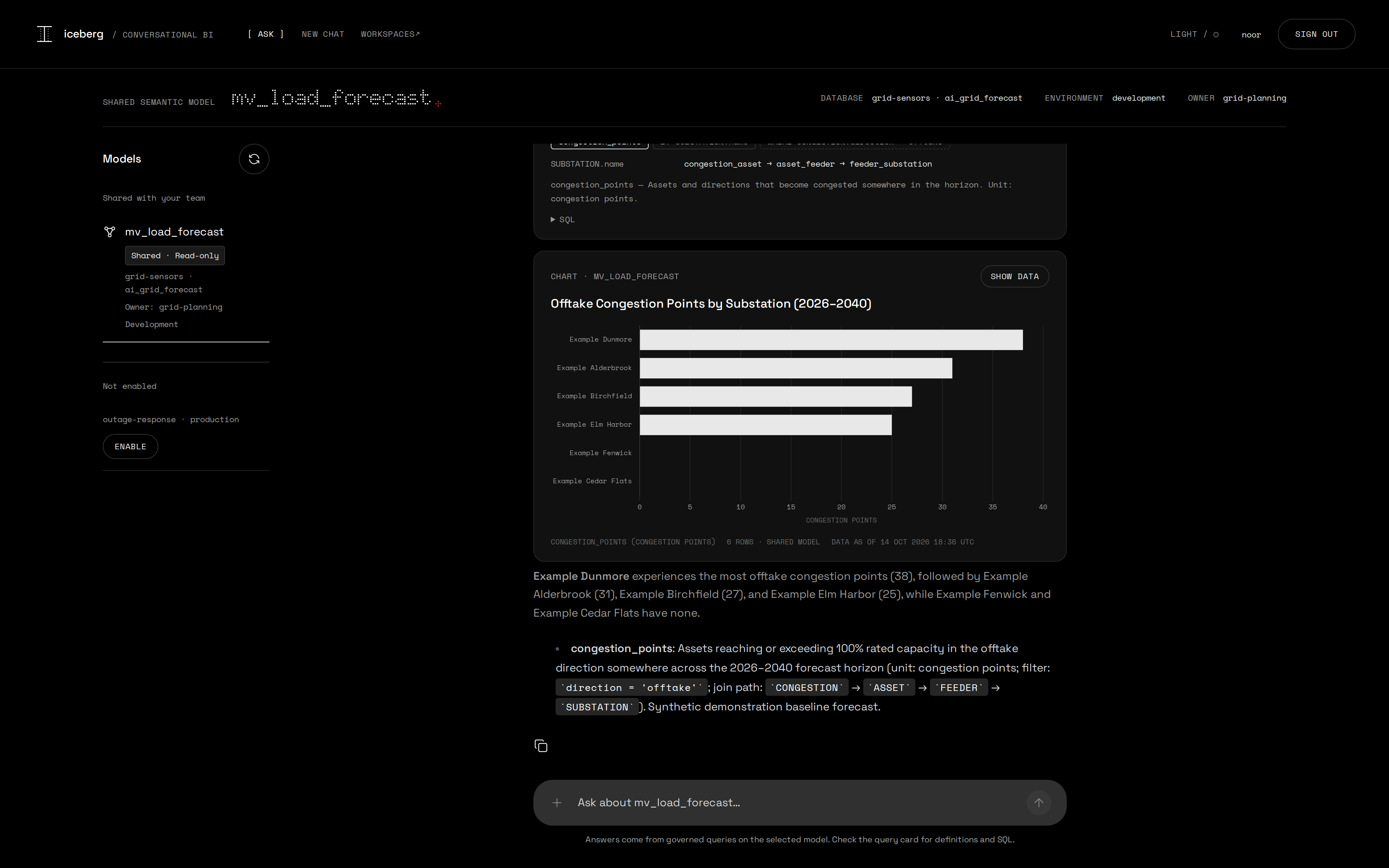
How a question becomes a governed query
As far as I'm concerned
- Iceberg complements platforms like Snowflake. Use it where openness pays off: data that several teams, engines or partners read. Not every table needs to be an Iceberg table.
- Combining data products is where an integrated platform wins. Joining many data products in one place with good performance is easier when storage, compute and catalog come from one vendor.
- For Iceberg tables, engines are replaceable. My advice is to treat them as workload decisions, not as platform commitments.
- Meaning belongs next to the data. A semantic model is part of the data product: owned by the team, checked before it is published, and shared and governed like the tables.
- Self-service only works with clear ownership. Teams create, own and share their databases, while the platform team owns the building blocks.
- Agents use the same front door. They get the same identity and grants as the people they work for.
- Keep the core small, grow through extensions. New capabilities such as Conversational BI, dbt pipelines, Ingestion and OpenMetadata come with their own release, behind one versioned contract.